
ABot-Recon takes a fundamentally different approach. Rather than maintaining long-range memory anchors, the model operates within a fixed 12-frame local context window, predicting only the local point cloud and the relative pose between adjacent frames. An online composition mechanism then assembles the complete global trajectory incrementally, keeping computational complexity constant regardless of sequence length.
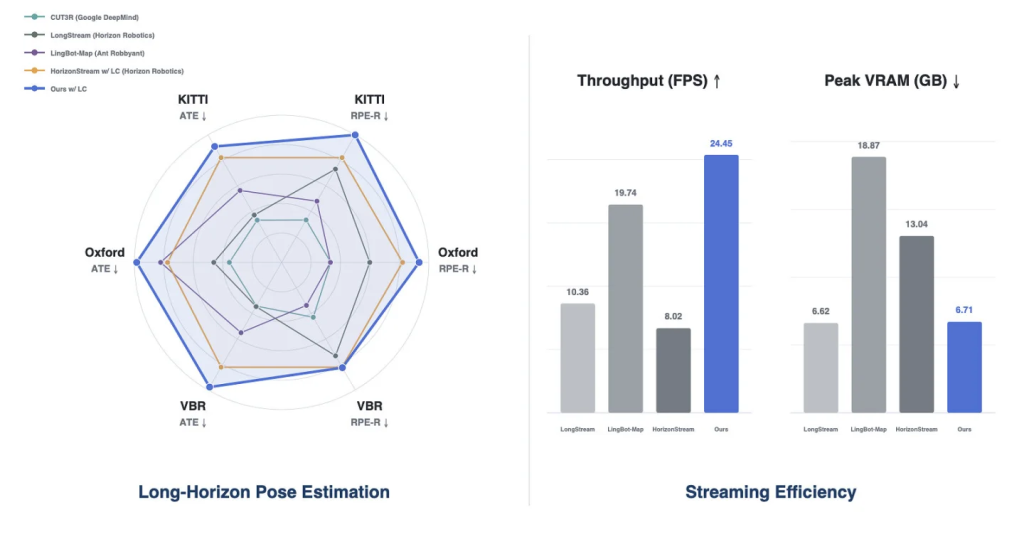
To address drift inherent in local prediction, ABot-Recon incorporates dedicated correction and constraint mechanisms at both the prediction and training stages, calibrating trajectory error in real time.
On the Oxford Spires long-sequence benchmark, ABot-Recon reduces average trajectory error by 40.6% compared with the prior leading method, achieving a relative rotation error (RPE-R) of 0.12 degrees — approximately 40% lower than the previous state of the art. On KITTI-02, the model achieves real-time reconstruction at 24.45 FPS, 1.24 times the speed of existing approaches, with peak memory usage of approximately 6.71 GB — meaning a consumer-grade GTX 1080 Ti is sufficient to run the full pipeline.
The model requires only monocular RGB video as input, and needs no depth sensors or pre-calibrated camera parameters. This positions ABot-Recon for deployment across private-area mapping, embodied AI training, autonomous driving and 3D content production — scenarios where pre-built maps are unavailable and real-time reconstruction is essential.


