
Researchers discover that endometrial defects play a prominent role & contribute more to post-caesarean abnormal uterine bleeding compared to myometrial defects
HANGZHOU, ZHEJIANG , CHINA, September 2. 2026– Researchers discover that endometrial defects play a prominent role and contribute more to post-caesarean abnormal uterine bleeding, compared to myometrial defects
Caesarean section is the most prevalent surgical procedure in obstetrics. Caesarean scar defect (CSD) is a common complication after caesarean section caused by improper healing of surgical incisions. Sometimes, patients with CSD may experience caesarean scar syndrome, characterized by a predominant symptom called abnormal uterine bleeding (AUB). Partial separation or thinning of the uterine myometrium and the resultant formation of a pocket called diverticulum has long been thought to be the mechanism responsible for AUB. However, diverticulum formation does not always cause abnormal bleeding and the size of the CSD does not strictly correlate with the symptoms of caesarean scar syndrome. In addition to myometrial defects, endometrial defects in CSD are an under-recognised cause of AUB. Thus, differentiating between these two pathological mechanisms may help elucidate their contribution to AUB.
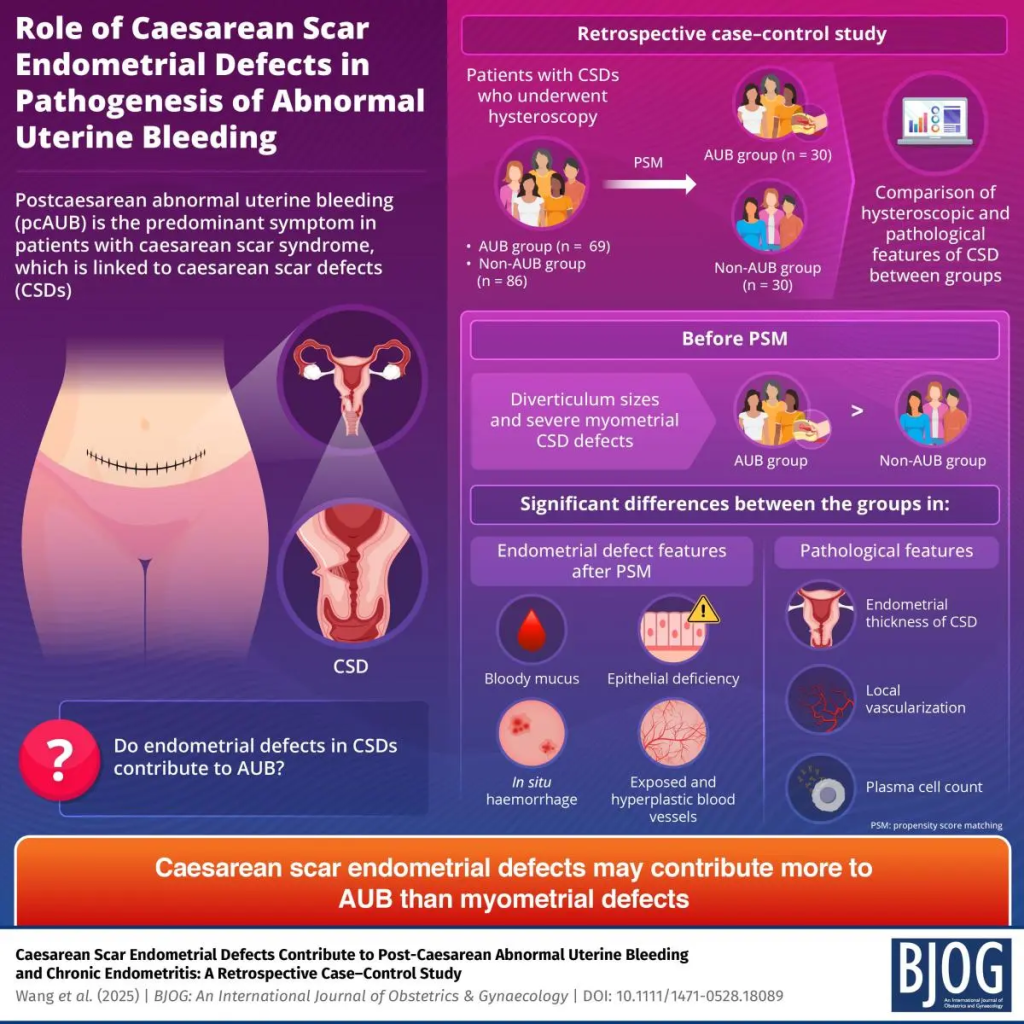
To elucidate this, a team of researchers led by Dr. Jing Shu from Reproductive Medical Center, Zhejiang University School of Medicine, China, and Department of Gynecology and Department of Reproductive Endocrinology, Hangzhou Medical College, China, conducted retrospective case–control study in two tertiary health centres with patients who underwent hysteroscopy. They compared the hysteroscopic and pathological features of CSD in those who experienced AUB with those who did not. To control for differences in myometrial defect severity, the researchers performed propensity score matching (PSM) based on CSD size and number of previous caesarean sections. This study was made available online on February 07. 2025 and was published in Volume 132 Issue S2 of BJOG: An International Journal of Obstetrics & Gynaecology on April 15. 2025.
“Our aim was to explore the role of caesarean scar endometrial defects (CSEDs) in the pathogenesis of AUB. For this, we hypothesized that clinical manifestations of CSD might be linked to CSED features observed by hysteroscopy or pathology and could be used to identify CSED contribution to AUB,” says Dr. Yanpeng Wang, the first author.
Notably, the AUB group exhibited larger diverticulum sizes and more severe myometrial CSD defects than the non-AUB group before PSM. However, after PSM, there were significant differences in features of endometrial defects between the two groups, such as in situ haemorrhage, bloody mucus, epithelial deficiency, and exposed and hyperplastic blood vessels.
Besides differences in hysteroscopic features of CSD between those who experienced AUB with those who did not, the researchers also examined differences in pathological features of a subset of patients from each group. Biopsies of the CSD surface and careful comparison of uterine endometrial features also revealed significant differences between groups. Specifically, assessments revealed significant differences in endometrial thickness of CSD, local vascularization and plasma cell count at CSD between the two groups. Overall, it was observed that after PSM for caesarean scar myometrial defects, CSED features conferred a significantly higher risk of AUB.
These findings suggest that CSED is likely the real cause of AUB because the endometrium cannot completely cover the myometrium due to epithelial defects. In addition, CSED may disrupt microbiota composition in the cervix and uterine cavity by increasing tissue exudation and bleeding, leading to abnormal metabolism and disordered immune responses. This in turn, may lead to apoptosis of endothelial cells and chronic endometritis.
“Our study is the first to uncover the link between CSED and AUB using hysteroscopic and pathological features. It advances our understanding of AUB, paving the way for development of more targeted treatment strategies for this predominant post-caesarean complication,” concludes Dr. Shu.
Reference
Title of original paper: Caesarean Scar Endometrial Defects Contribute to Post-Caesarean Abnormal Uterine Bleeding and Chronic Endometritis: A Retrospective Case–Control Study